
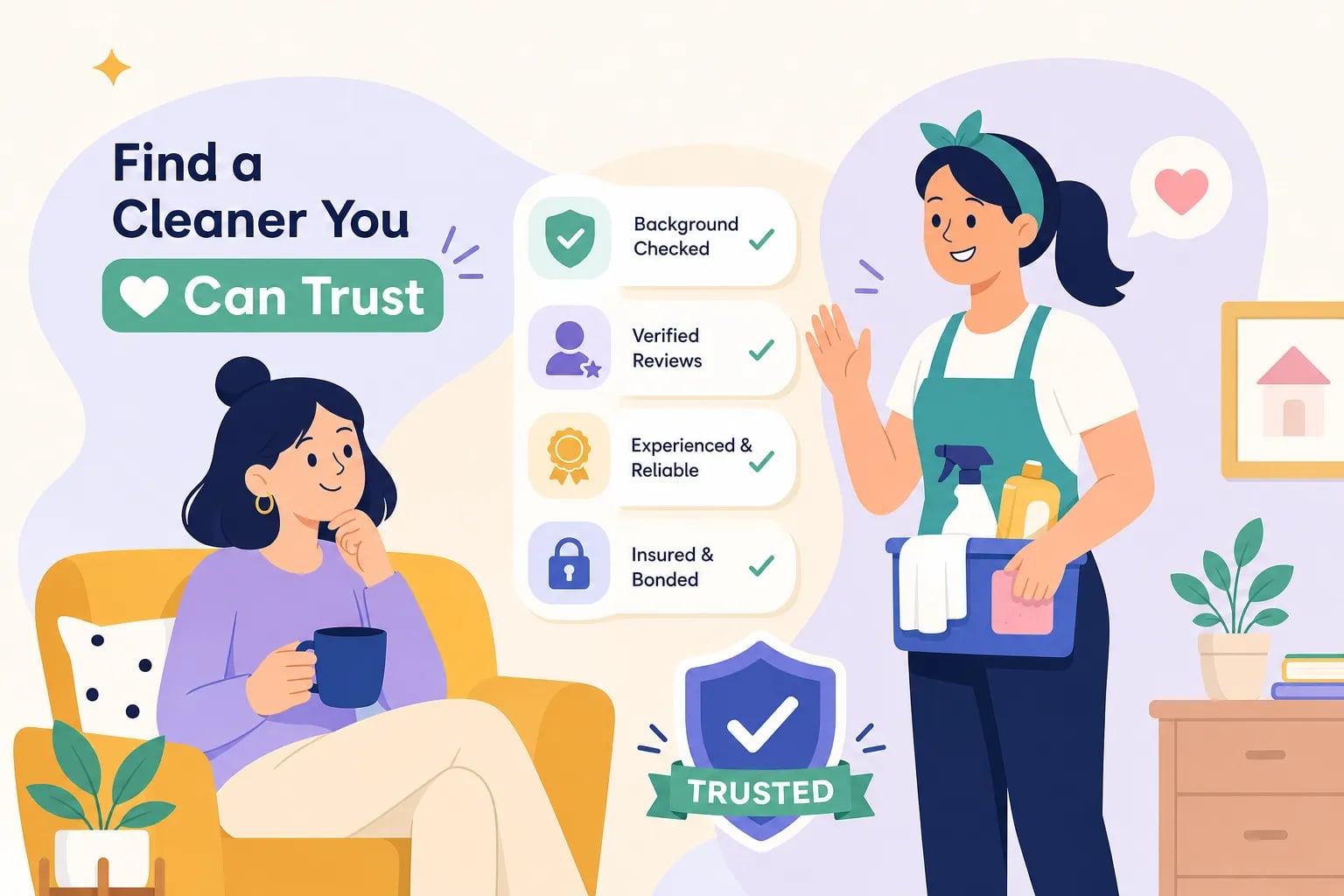
How to Find a Trustworthy House Cleaner
Finding a trustworthy house cleaner is one of the more significant decisions you’ll make as a homeowner. Inviting someone into your home while you’re not there is a real act of trust, yet many people hire a cleaner based on a quick Google search, a decent star rating, and a pleasant-sounding phone call. That process rarely reveals what actually matters: whether the person coming through your front door has been properly vetted, carries insurance, and will deliver the same standard of clean on their tenth visit as they did on their first.
A reliable house cleaner is defined by more than a friendly manner and a timely arrival. The real markers of trustworthiness are verifiable: credentials you can confirm, references you can actually contact, and a written agreement that protects you when something goes wrong. This guide covers exactly what to check, what to ask, and what to walk away from, so you can hire with confidence rather than hope.
What “trustworthy” actually means for a house cleaner
Most people equate trustworthiness with showing up on time and being polite. Those qualities matter, but they’re easy to fake on a first visit. Real trustworthiness rests on three pillars: verified credentials, consistency across every visit, and the values the cleaner or company brings to the relationship.
In New Zealand’s residential cleaning market, these three qualities are not always present in the same provider. The industry is not licensed in the way some trades are, there is no mandatory requirement for Police vetting or public liability insurance, which puts the burden squarely on you to do the verification work before you hand over a key.
Credentials, consistency, and care: the three pillars of a reliable cleaner
Credentials mean verifiable checks: Police vetting or a Ministry of Justice criminal record check, public liability insurance, and employment status that’s clearly defined.
Consistency means the standard of your second, fifth, and twentieth clean matches your first, not just the one you were watching.
Care is the values piece: does the cleaner approach your home as a place that matters, or purely as a job to tick off?
When any one of these pillars is missing, the arrangement has a gap. A cleaner who is pleasant and police-checked but inconsistent will frustrate you. One who is consistent but uninsured becomes a problem the day something breaks. All three need to be present before the relationship earns the word “trustworthy.”
Why cultural values in a cleaning service aren’t just marketing
Some cleaning services embed genuine values into how their teams are trained and how they approach a client’s home. At Pure Aroha Cleaning, the Māori concepts of whakapai (to prepare and make good) and aroha (love and genuine care) shape the way every clean is carried out. That’s not a tagline, it changes the nature of the relationship from a transaction into something more like a partnership. In practice, this means staff treat a misplaced ornament or an accidental scuff with the same care they’d want shown in their own home, and they communicate about it rather than hoping you won’t notice.
When a company’s values are visible in how staff communicate, how they handle breakages, and how they treat a client’s belongings, it signals that the culture supports the credential. That’s something a generic franchise finds difficult to replicate.
How to choose a trustworthy house cleaner: vetting checks you should always ask for
New Zealand has two distinct types of checks relevant to domestic workers, and they are not interchangeable. Understanding the difference protects you from accepting a lesser check dressed up as something more comprehensive.
NZ Police vetting vs Ministry of Justice checks: what’s the difference
A New Zealand Police vet is the more comprehensive of the two. It may include not only convictions but also pending charges, charges without conviction, warrants, family-violence involvement, and other relevant Police interactions. Critically, it can only be requested by an authorised organisation, not by a private individual. A residential cleaning company must be registered as an authorised Police-vetting agency to obtain this check for its staff.
A Ministry of Justice criminal record check covers conviction history only. It’s narrower in scope, but available through a broader range of organisations and is the lawful route for most private household employment arrangements. Neither check has an official expiry date, so always ask when the check was conducted and whether the company repeats it periodically. You can verify whether a cleaning company is an authorised vetting agency by checking the New Zealand Police’s official list of authorised agencies.
Insurance and employment status: the questions most homeowners forget
Public liability insurance covers accidental damage to your property and third-party injury claims during a clean. An established insured cleaning service should carry at least NZ$2 million of public liability cover; sole operators should carry a minimum of NZ$1 million. A certificate of insurance is the right standard of proof, a verbal assurance or a claim on a website is not.
Employment status matters too. If the cleaner is an employee of the company, the company carries the liability. If they’re an independent contractor working under the company’s brand, the picture is less clear. Ask directly who holds the liability if something is damaged or someone is injured during the clean.
How to verify a cleaner’s vetting claims yourself
Ask the company to confirm in writing that it is an authorised Police-vetting agency, including the date each relevant staff member’s check was conducted. Cross-check the company’s name against the Police’s published list of authorised agencies. For insurance, request a current certificate: check that it specifically names domestic or residential cleaning, and note the coverage limit and expiry date. Don’t accept “we’re fully insured” without documentation. If a company can’t or won’t provide this, treat it as a signal about how transparent they’ll be once they have access to your home.
Where to find vetted cleaners and how to read their reviews
No single platform gives you the complete picture. The most reliable approach is to use two or three sources in combination and look for patterns rather than picking a provider based on a single glowing review. Whether you’re searching for a house cleaner near me in Wellington, a domestic cleaner in Auckland, or a background-checked cleaner in Christchurch, the same verification steps apply.
The NZ platforms worth your time and why
Start with TopChoice for curated local shortlists: it publishes “Top 5” lists by location, with an emphasis on vetted staff and reliability. Use Neighbourly alongside it, verified-neighbour recommendations carry more weight than anonymous star ratings because you know the reviewer lives in your area and used the service themselves.
Cross-check each shortlisted provider on Google Business Profile and NoCowboys, which uses authenticated ratings that are harder to manipulate than open review systems. Airtasker NZ is useful for individual cleaners and one-off jobs because reviews are tied to completed marketplace transactions. Facebook community groups can surface strong hyperlocal recommendations, but they require more manual verification, ask commenters directly whether they hired the cleaner and what the result was.
What genuine reviews look like vs inflated ratings
Authentic reviews mention specific tasks (the oven, the grout, the ceiling fans), note timing and communication, and often describe what happened when something didn’t go perfectly. That last detail is particularly telling: a provider who handled a complaint well and corrected the issue is worth more than one with a spotless but suspiciously uniform track record.
Be cautious of a page full of five-star, one-sentence reviews with no detail, that pattern is a warning sign. Prioritise providers with a smaller number of detailed, balanced reviews over those with dozens of vague ones. Also check recency: reviews older than twelve months tell you less about current service standards than those from the last six to twelve months.
Questions to ask a trustworthy house cleaner before you hire
Before granting access to your home, you need clear, specific answers to two sets of questions: one about the people doing the work, and one about the practical arrangements that govern the relationship.
About crew, consistency, and credentials
Ask who will physically be cleaning your home, not just who owns or manages the company. Confirm whether the same person returns each visit or whether the company rotates staff. If a substitute is ever sent, find out how that person is vetted and whether you’ll be notified in advance. Consistency of staff is a trust signal in its own right, a company that rotates cleaners without notice forces you to establish trust repeatedly, while one that assigns you the same person builds a genuine working relationship over time.
Confirm that the specific person entering your home has completed the appropriate check, whether that’s a Police vet or a Ministry of Justice criminal record check, and ask the date it was conducted.
About access, damage handling, and supplies
Clarify who holds your key or access code, whether copying or sharing is expressly prohibited, and what happens to that access when the arrangement ends. Ask for the process if something is damaged: is there a written claims window, a remedy process, and does it sit under the company’s insurance? The damage process should be in your written agreement before any clean takes place.
Find out who supplies the cleaning products and whether you can request fragrance-free, pet-safe, or allergy-sensitive alternatives. If you have specific surfaces, medications, valuables, or rooms that are off-limits, document these in writing before the first visit rather than relying on a verbal briefing.
Red flags that should make you walk away
Red flags are most meaningful as patterns rather than isolated incidents. A cleaner who is slightly slow to respond to one message is not necessarily unreliable. However, if a cleaner is vague about vetting, won’t provide references, pushes to start without a written agreement, and quotes an unusually low price, that combination should stop the conversation.
Warning signs in the conversation before you book
A trustworthy cleaner or company answers vetting questions directly and without defensiveness. Three specific warning signs to watch for:
- They use vague language about “background checks” without naming the type of check or the authorised agency that conducted it.
- They can only supply references themselves rather than pointing to independently verifiable reviews.
- They pressure you to start immediately without a trial clean or written agreement.
Willingness to be transparent about credentials before the first clean tells you a great deal about how a provider will behave once they have access to your home.
Pricing and contract red flags that reveal corners being cut
Current 2026 residential cleaning rates in New Zealand run from roughly NZ$35 per hour for independent cleaners to NZ$80 per hour through established companies, depending on the city and scope. A quote significantly below NZ$35 per hour, which sits at the lower bound of typical independent-cleaner rates, warrants a direct question about how the cleaner is vetted and insured. It often signals unvetted staff, no liability cover, or inadequate time allocated per visit.
No written agreement is itself a red flag. Watch for liability waivers buried in fine print, damage-reporting windows as short as 24 hours with no remedy process attached, and companies that can’t produce a current insurance certificate when you ask. These aren’t minor oversights, they’re signals about how disputes will be handled if something goes wrong in your home.
Choosing a cleaner you can actually rely on
Hiring a trustworthy house cleaner becomes straightforward when you know what to look for. Check credentials first: confirm the type of vetting check, the date it was conducted, and whether the company holds current public liability insurance. Use TopChoice and Neighbourly to build your shortlist, cross-check each provider on Google and NoCowboys, and look for detailed, recent reviews that describe real experiences, including how complaints were handled.
Ask the right questions before access is granted: who will be cleaning, whether the same person returns, how substitutes are screened, and what the process is for damage or missed work. Put the key terms in writing before the first clean takes place. Then book a trial clean, inspect the result honestly, and assess how the company communicates throughout.
If you’re in the Wellington region and want a cleaning service that combines verified credentials with genuine care, get in touch with the team at Pure Aroha Cleaning. Our staff hold current Police vetting and we carry public liability insurance, we’re committed to the same standard of clean every visit, not just the first one. Reach out to book a consultation or a trial clean, and find out what a relationship-based cleaning service actually looks and feels like.